

Attack the Week (ATW)
Traitors & Faithfuls / USDJPY / Calendar / Charts / Allocation Update

Sunday Thoughts
Last Friday’s UK Traitors finale genuinely got under my skin. Watching people miss what, to the viewer, feels obvious is infuriating. Of course, the viewer advantage is the entire point: I get to know who is who, while the players are trapped inside a fog of incomplete information, social pressure, and incentives that punish clarity.
For anyone who hasn’t watched it, the concept is brutally elegant. A small hidden minority, the Traitors, operate inside a larger group, the Faithful. The Faithful must identify and vote out Traitors, while the Traitors secretly remove Faithful each night. What looks like a show about personalities is really a show about inference under uncertainty: how people form beliefs, coordinate, and accuse when the cost of being wrong is elimination.
Game-theoretically, the show is a reminder that truth is not the same as winning. In a multiplayer game with hidden types, the best move is often not the most accurate one, but the one that survives the social equilibrium. The clearest thinker can be voted out precisely because clarity is threatening. Meanwhile, the safest strategy for many is to mirror consensus, avoid sharp claims, and let stronger personalities do the work. It feels irrational until you accept the payoff function: survival beats correctness.
It is hard not to see a parallel in the current geopolitical setup. When a dominant player openly weaponises attention and punishment, the game stops being about rules and becomes about reading intent. Trump’s latest threat to impose sweeping tariffs on Canadian goods if Canada pursues a trade deal with China is a clear example of that dynamic: the message is not subtle, and it is not negotiated through the usual rituals of diplomacy. It is stated as a condition of obedience.
So what is the optimal play in a world like this? It probably is not to play the perfect game in public. It is to play a competent, objectively defensible game in the open, while quietly preparing alternatives when nobody is watching. In Traitor’s terms, you behave in a way that keeps you off the nightly hit list, but you still keep your own map of the room, your own probabilities, your own exit routes. In geopolitics, that means states signal alignment and reasonableness while also building redundancy, deepening optionality, and reducing single points of failure.
The market implication is that we are back in a genuinely multiplayer regime, where outcomes depend on expectations about other players’ expectations. That tends to shift the Macro conversation quickly back to first principles: not just where the US Dollar should trade, but who is willing to tolerate which outcomes, and how coordinated the constraints really are.
Which brings us to the move that felt like it came straight out of a Traitors episode. Late in the UK trading day on Friday, USDJPY suddenly plummeted by roughly 1.5% after reports that the New York Fed conducted rate checks on the currency pair. Rate checks are not an intervention, but they are nothing either. They are a signal that someone wants the market to know they are watching, and that the cost of testing levels may be rising.
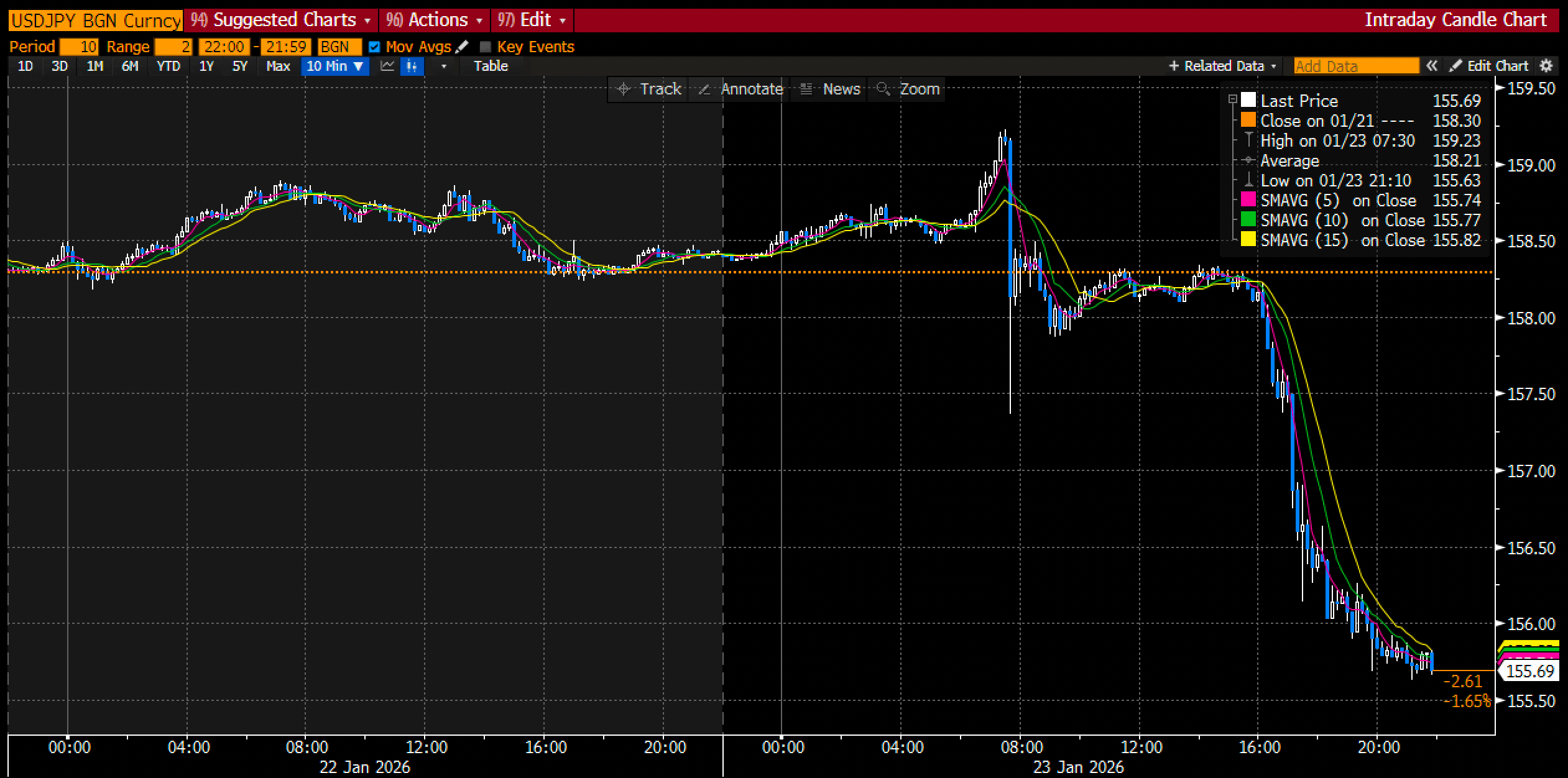
The intriguing part is the ambiguity. Was this simply Japan’s familiar playbook, leaning on the threat of action near politically sensitive levels, or something more coordinated, with Washington at least tolerant of a stronger yen? Reporting and market chatter reflect that uncertainty. And whenever coordination even becomes plausible, the ghost of 1985 inevitably shows up in the room.
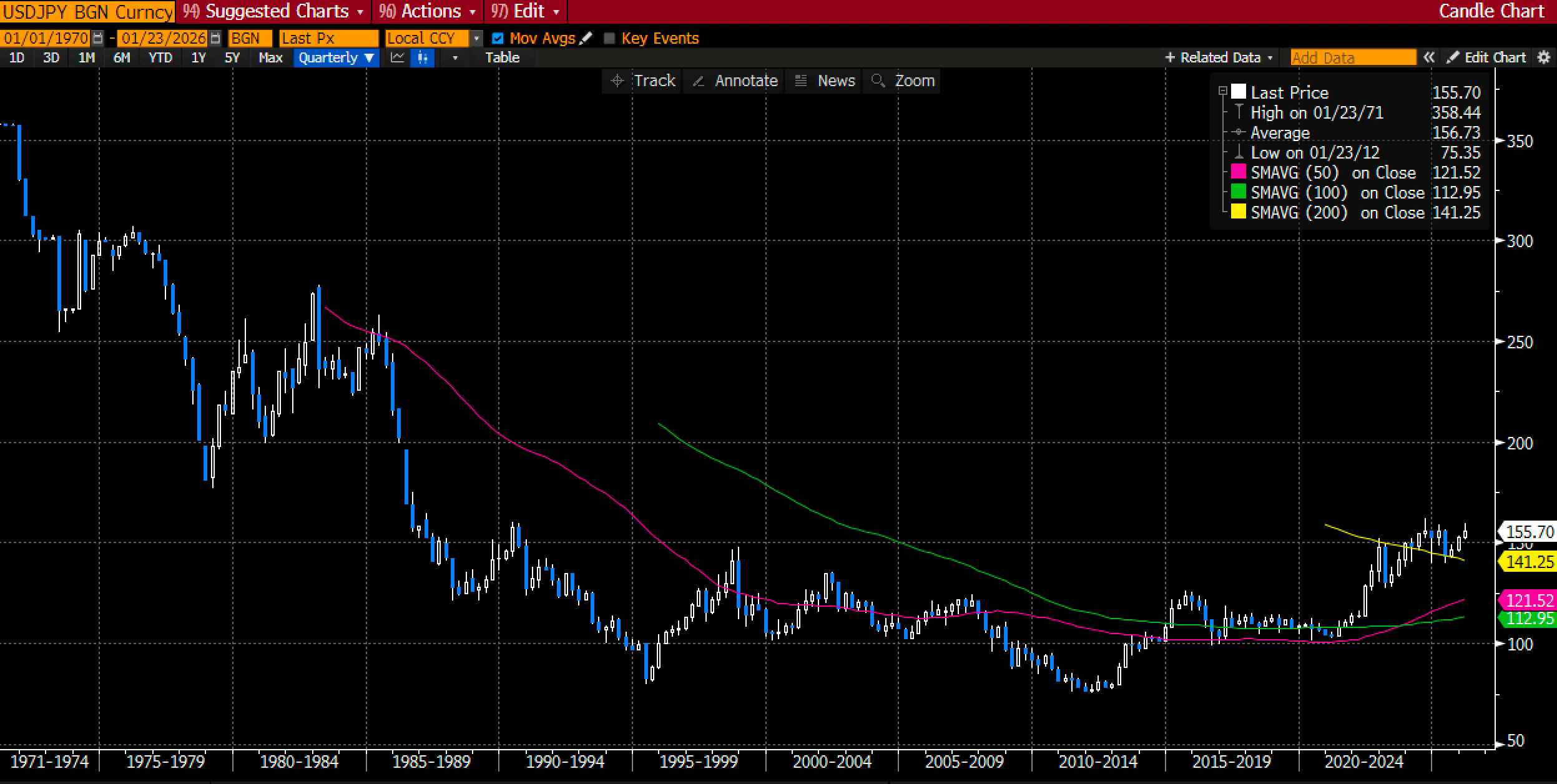
Is this the beginning of a new Plaza Accord? It is far too early to say, and the sensible stance is to treat that idea as a narrative until there is sustained evidence of policy alignment, repeated signalling, and follow-through. Still, even the hint of US involvement changes the game, because it shifts the distribution of outcomes. If the market starts to believe that official tolerance for dollar strength has a ceiling, the dollar can fall further than positioning and macro differentials alone would justify, simply because the tail risks have been repriced.
The broader lesson from the geopolitical tensions, week after week, is that in multiplayer systems, the biggest moves do not come from facts becoming known. They begin when the room collectively realises that the rules may have changed. I think the rules have changed decisively since “Liberation Day”. The macro roadmap I laid out back then is still very much active. I have laid them out in detail in the post below.
Waiting for April Fools + 1

With quarter end now firmly behind us, we and everyone else are awaiting April 2nd and with it the potential repercussions. A seismic event for financial markets or just another one of those unclear presidential communications where everything is still very much up to interpretation? I am not sure financial markets want to grapple with continued uncertainty and are pricing in enough event risk premia in case we are indeed presented with a historical event. I wrote about it in
Macro D’s Trade Corner of preferred Macro FX trades has come to a flying start this year so far, while our buy-and-hold portfolio for 2026 crossed +5% YTD on Friday. Behind the paywall, he is updating readers on changes to his book after a very successful week. Let’s also analyse the weekly calendar, look at some interesting chart setups, and interpret the output of our weekly asset allocation model.
Let’s go! Have a wonderful week ahead.
