

All Gates, All Barbarians
The Moment Force re-entered the Language of Order

Some events are too easily dismissed as isolated episodes. Others, though, open fractures that travel far beyond their point of origin. The capture of Nicolás Maduro belongs to the latter category—not for its spectacle, but for the precedent it sets and the language of power it reveals.
This second part of All Gates, All Barbarians steps back from the event itself and looks instead at what it signals about the macro world we are entering. When intent is stated openly, when force replaces ambiguity, and when old constraints quietly dissolve, both history and markets begin to rhyme in unfamiliar ways.
I have removed the paywall for this post as Macro D returns to the broader macro framework introduced in the first piece, drawing on historical parallels and translating this evolving landscape into the mindset—and adaptations—required of macro traders today.
by Macro D
The Hollywood-style capture of Maduro has opened a breach in the macro world, one that cannot be dismissed as a “single episode” attributable to a specific longitude. The spatial reflection of this event is a long, incisive, and indefinite shadow. As such, it foreshadows the kind of scenario that this series of pieces, titled “All Gates, All Barbarians”, intends to study meticulously, to capture a concrete communion of intent between what the macro world narrates through these pieces and what the macro world puts into play through the “Trade Corners”.
What does it mean to “be human?” and what does it mean to “be macro traders in an era in which human beings no longer know what it means to be human?” I will humbly attempt to answer these questions, providing a first follow-up to the piece “All Gates All Barbarians” in the hope that my thoughts, and consequently my words, will be able to frame the macro spectrum from the highest point of that mountain, to which I have repeatedly referred over the past year to describe my macro process. As always, to unravel the mystery, I will use as my points of reference the most glorious material of all (namely, history) and some of those characters that history, in the course of its glorious unfolding, has served us on its platinum platter.
Antigone is the most human of Sophocles’ tragedies, first performed in 442 BC. It tells the story of the heroine who challenges the tyrant Creon to secure a burial for her brother, Polynices; in this attempt, the conflict between divine and human law comes into play. Antigone thus becomes the symbol of those who fight for individual rights and freedom of conscience against a power that proves despotic. Well, let’s come to the present day.
Is the following translation, which casts Donald Trump as Creon (the tyrant) and the rest of the world as Antigone, legitimate?
In Antigone, we witness a conflict with no winners, but only an intense struggle between the individual and the state, which provides the backdrop for a profound reflection on the meaning of “being human.” And in our day, what are we witnessing? We see the dawn of a struggle between the United States and the rest of the world, which provides the backdrop for a profound reflection on the meaning of “being human”, but in a completely different time than Antigone’s.
Now, let’s clear up any misunderstandings and seek the link between Antigone’s time and Trump’s time, attempting to retrace the steps of those who study the time that history presents to them. In ancient Greece, the art of divination was fundamental for predicting the future, and was based on the work of oracles (such as the Oracle of Delphi). Dream interpretation (oneiromancy) also existed, as did the observation of natural phenomena (lightning, thunderstorms, natural disasters). It was through these arts that a direct connection between the human and divine worlds was sought, in an attempt to uncover how the will of the gods was revealed through signs and omens.
And today? Given that, albeit in other forms, the art of divination still exists, I am referring here to that kind of art that concerns us all very closely, since it allows us “each based on the initiatory modalities of their own personal culture”, to target the world through a vision that is the product of our way of looking at things in this world. In short, if ancient Greece had the art of divination, we, the men of 2026, have the art of macro vision. To each his own.
That said, I am now attempting to climb to the highest point of that mountain again and try to put down on paper my personal macro vision, following the route already traced in the first part of “All Gates All Barbarians” and broadening the scope to all those players who, by virtue of their position/power, play a decisive role in this geo-global puzzle, up to the—for us—fundamental translation of this macro vision into a trading strategy.
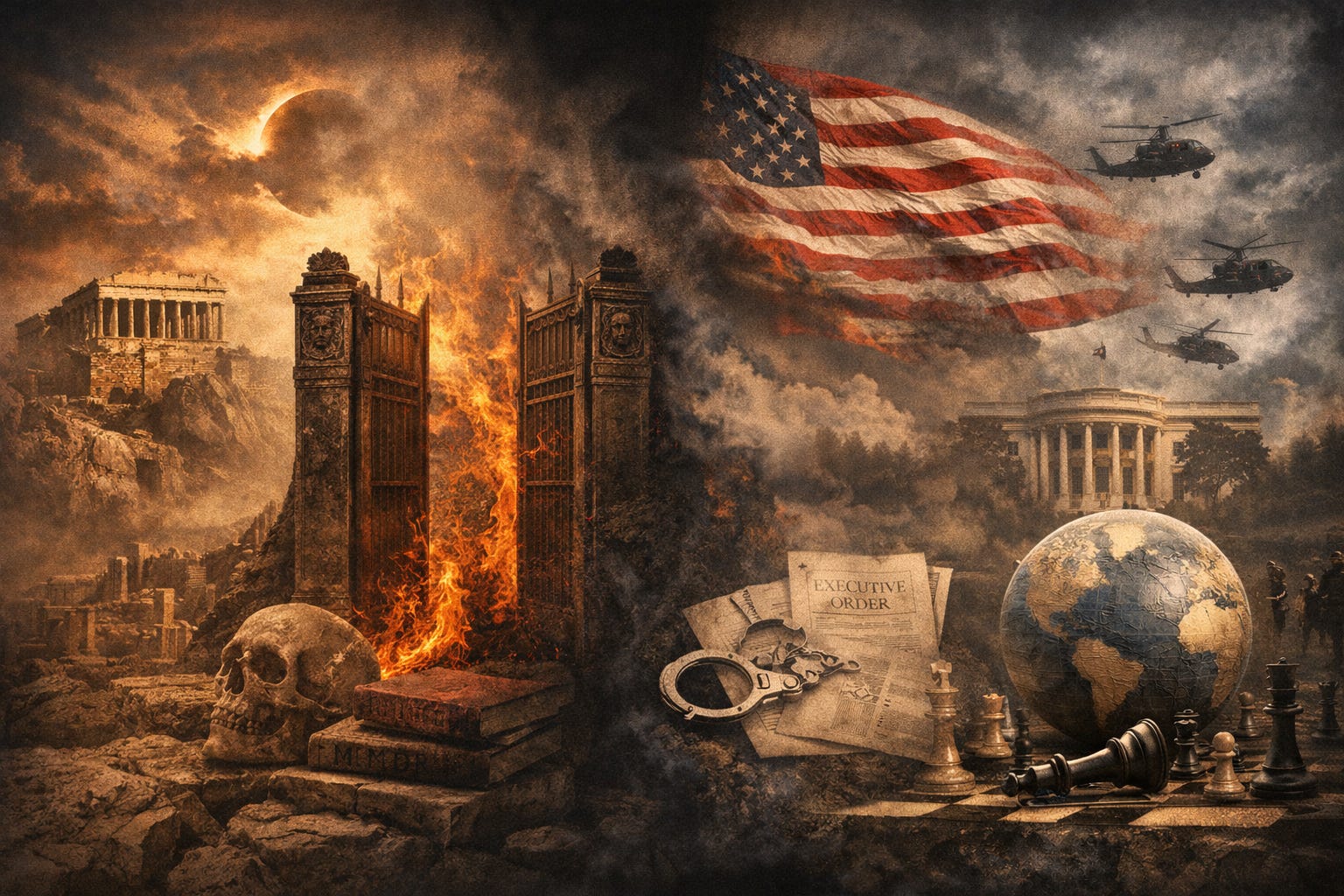
No one knows the future, least of all a humble human being like myself. Still, I don’t think it’s necessary to boast of being part of Nostradamus’s family tree to assert that in a few years, “the days of the olive branch” will be definitively swept away. We are about to enter, with both feet, into a world—the real one—governed by power and force. That’s all. There’s no point in beating around the bush; the more I look around, the more I am surrounded/fascinated by a macro vision that is anything but bucolic. Those who dare to face reality are preparing for the events that will arise from this macro process that has just begun. Those who lack the courage to update their economic/political/financial beliefs will soon find themselves dealing with the loss of what remains of their shattered sovereignty.
Now, the capture of Maduro, orchestrated by Trump, rightfully enters the history books. If this world still exists in a hundred years, if teenagers still go to school, and if a school subject called “History” exists, those teenagers will likely be asked to remember that day when the American president kidnapped the Venezuelan president. Maduro’s capture marked a watershed moment, one that goes far beyond the seizure of the planet’s most important oil reserves. Here, the message is more profound and evokes the dawn of those times when the great leaders of the past knew nothing of the world’s boundaries, but instead worked to conquer the entire known world.
Trump is no Alexander the Great, but he manages to manoeuvre the underbelly of the world he inhabits with the same astuteness with which the human brain directs all other parts of the body. “Planet Earth” is the setting for his reality show, and we humans must come to terms with it. Trump is the one who deals the cards because, among the powerful who sit at the table of the great, he is the only one who recognizes that in the world “there is good and there is evil” while all the other leaders on earth, for purely opportunistic reasons, gravitate in the limbo of hypocrisy that recognizes neither good nor evil and, never managing to see things in black and white, are incapable of producing a definitive and incontrovertible vision/choice. One might reply, “What if evil were Trump himself?” I don’t rule it out, but even if this were the reality, we would still have a much more apparent reality than the one the world would experience if there were no leader who, when he opens his mouth, does so to say what he truly wants done, and not to survive one more day in his nation’s highest seat.
I ask: Does anyone remember what the world was like before Trump? A quick review. It was a world in which those who could afford it, taking advantage of the night sky and America’s growing disengagement from various hot spots on the planet, pitched tents far from home, conducted business deals at latitudes distant from their own borders, and made deals in the name and on behalf of a future world that no longer envisioned the massive presence of the American superpower. And how did one react to this state of affairs? Those who accuse Trump today of wanting to colonise the world are the same ones who accused Biden of abandoning the world to its fate without lifting a finger. Let’s agree. They say the truth lies somewhere in the middle, but when the truth stops exactly in the middle, there’s always a good dose of hypocrisy in that middle. Like it or not, at the exact point where the new American will is unfolding, there is no hypocrisy at all. There is only one will: a very specific one. American first.
And proof that there’s no hypocrisy in this mantra is the fact that it’s been repeated ever since Trump returned to power. So, the problem isn’t with those who repeat the mantra, but with those who continue to ignore it.
I realise that accepting such a shift in perspective can cause more than a stomachache. We live in a world where, until recently, Joe Biden had the final say, while now the final say (and first) is The Donald’s. Such a change can’t be digested overnight. Imagine a house (the world) rented to a group of college students. Well, one day a college student leaves, and in his place comes a drummer with insomnia, a drinking problem, an oversized ego, a lack of respect, and a tendency to do whatever comes to mind. This is the picture. The reality we see before our eyes today is not very different from this. The drummer (The Donald) has been turning every tile upside down and shamelessly trampling on every roommate since he set foot in his new home. It’s not a question of intelligence; it’s a question of guts, ambition, arrogance, and the desire to go down in history. When a man (regardless of his religious/political beliefs) feels he’s acting in the name and on behalf of God, then anything can happen.
All this is happening before our eyes, and our macro trading cannot ignore the psychology of this man in sole command. How can I, for example, take a long-term position on the EUR/USD (or on a US government bond) when I know that this trade is necessarily destined to suffer the dialectical/behavioural/psychological wrath of a man who can influence the movement of this trade exclusively according to a logic dictated by the needs of the United States of America? This man’s psychology forces me to lower the timelines of my long-term trading, forces me to be more protective, forces me to sleep with my eyes open, forces me to remember that directionality could change at any moment, forces me to remember what I said in the first piece of this series:
“The macro market is no longer the same for two reasons: because it has expanded beyond measure and because the sheer flexibility of its movements allows it to change course at any moment”.
To survive in this macro environment, I must necessarily adjust my strategy, and I do so by lowering my time horizon and widening the monetary depth of my bet when I think I’m right. Therefore, following the example of the EUR/USD exchange rate (which I’m currently keeping my distance from), my response, in the era of Donald Trump’s macroeconomics, would be to open a position that isn’t intended to last for months, but merely for weeks. I would enter the position with a larger size than I would if my time horizon were longer. Simply put, I would attempt to regain, through the size of my position, the competitive advantage I would lose by undermining my time horizon.
That said, as a human being, I don’t care if Trump does this or that. I care that the office of the American President is held by a human being who does. And as a macro trader, I don’t care if Donald Trump is a loose cannon. I care that the office of the American President is held by a geo-macro variable capable of affecting every sphere (social, moral, economic, etc.) of the planet with the same exuberant nonchalance. This means that this president is capable of creating the conditions that allow the wheels of the macro machine to turn, and let me, as a macro trader, ask questions, seek answers, and design trades capable of delivering profits.
Well, I’m not saying that the world was in good hands before and is in bad hands now. I’m a macro trader; my job isn’t to pass judgment; it’s to look around and develop trades based on what I see. That said, the world needed a shake-up, as most of Trump’s actions aren’t contested on the merits (i.e., the root of his decisions), but rather on the methods. The point of contention isn’t what Trump does, but how he does it—that is, with the most rickety and rusty crowbar available.
Let me get to the point. The leaders who build barricades in front of Trump’s demands for Greenland aren’t building barricades because Trump wants Greenland; they’re building barricades because Trump clearly states that he wants Greenland, as if he were telling the taxi driver stopped in front of the Plaza Hotel, “Hey, take me to Staten Island!” This implicitly tells me that world leaders know Greenland must end up (one way or another) under American control, but what they can’t stand is being seen as servants (which they regularly are) every time Trump takes centre stage. The world before Trump was a sleepy planet that thrived on sleeping pills (moral/economic/financial/social) rather than water. Trump’s world has banished sleeping pills and thrives on instinctive and vigorous exuberance. If the world we left behind was the ideal home for a sleepy democracy clinging to its dream, the world we now face is that of a democracy that will soon (like it or not) have to go to the registry office to change its name.
Once again, I reiterate: I’m not saying that “this last world” is right and “the one we left behind” is wrong. I’m simply saying that this is not the first time in history a human being has been presented with Donald Trump’s moral/social characteristics. Sooner or later, a child always emerges from some hospital cradle, looks around, and says, “I’m worth much more than you.” To prove this point, the now adult child casts aside any social, cultural, or moral qualms because his sole goal is to demonstrate his greatness in the face of the smallness of his contemporaries. That blond boy grew up, went from palaces to casinos, and then to world government. I’m not interested in how he made his way; I’m interested in understanding where the road that bears his name leads. To leave the past behind, I think I still have to try to answer one question: “How was all this possible? How come no one saw The Donald’s long wave coming?”
To answer this question, I can’t help but turn to the spiritual realm. Many prominent analysts paint the current global picture as one in which the religious sphere is definitively fading, making way for an unbridled “ego-logy” (ideology), where those who, before setting out on a journey, worry about destroying the path that other travellers should travel are gaining ground. This perspective intrigues me, and the reason is easy to explain. The Donald, the leading representative of this ego-logy, absolutely does not reject the religious sphere, as he considers himself (even more so after the assassination attempt he escaped during the presidential election) as God’s anointed, chosen to restore world order. According to this vision, God should not be considered lost at all, but alive and well, fueling the mission of The Donald, who makes no secret of his honour. Trump speaks to the human gut, and he does so with the nihilistic attitude of someone who uses the five senses: “Look at the world, observe, hear, smell, touch. All this can be yours. Take it.” This is music to the ears of those segments of the population (primarily Americans) who, in the recent past, have felt oppressed by a convenient democracy, like the one proposed by Biden and, before that, by Obama. But it wouldn’t be correct to say that Trump only fascinates a large portion of the American public. Trump fascinates, albeit with obvious distinctions and percentages, everywhere in the world, as he presents the figure of an American President without filters, without superstructures, without hypocrisy. If there are those (as indeed there are) who think Trump can straighten out the world, it’s because they are there for all to see, those Trump counterparts who, scattered around the world, wouldn’t even be capable of organising a school trip, but to them is entrusted the task of organising the rebirth of their own nation-states.
That said, why has Trump stepped on the accelerator now? Because he has a clear vision. The midterm elections will be held in November, and he wants to arrive there with the attitude of a president who can say, “Look how respected the United States of America is now, and remember how they were laughing at us before I returned to Washington.” Trump knows that November will be a critical electoral test, and he wants to arrive there looking triumphant. To achieve this, he knows he must rely on his greatest strength, namely “being more and more Trump”, that is, an increasingly exuberant and exaggerated version of the Donald of the day before. This means that from now until November, The Donald will spare no one and show no consideration, and this second year of his presidential term will be even more impactful than the last. Trump will not stop, and for this reason, I hope that the internal dynamics of the United States of America (such as the Supreme Court) will not get in the way, attempting to block, through legislation, what the guts of the United States of America ardently desire. If history is speaking a new language, it would be appropriate for the guardian of American history (the law) not to intervene forcefully with the sole partisan purpose of curbing what the guts of the American people are demanding: America First. It’s not about leaving the dragon free to breathe fire on anyone; it’s about allowing this page of history to be written with the ink of truth, not with that “artfully outlined” by powers plotting in the shadows.
I cannot help but return to the cornerstone of the Trump administration’s policies. The National Security Strategy document, released by the White House in early December, emphasises the primary objective of preserving and strengthening the United States’ global primacy, which must absolutely remain the strongest, most prosperous, most powerful, and most successful country in the world. To dominate the world, the only permanent interest of the United States is the interest of the United States of America. Pure and simple. Unilateralism is dead (with all due respect to the European puppets stationed in Paris, Berlin, and London), and only multilateralism exists, based on power relations, certainly not on “comic international law.” Now the United States is considering returning to domestic production (factories and industries are returning to working-class America) rather than exporting “the dying dream of democracy.” The consequence of this change of direction is clear: “We do not accept interference in our decisions, much less when the territorial boundaries of our power are at stake.” The United States no longer wants unwelcome guests (like China and Russia in Venezuela and South America generally), nor does it want its trade jeopardised by an exuberant attempt to seize future sea routes (what China and Russia have been trying to do for years with Greenland’s Arctic routes). In short, things are serious here. Trump wants to restore the logic of a world in which, when one thinks of a superpower, one thinks of the United States of America and no other. As I have repeated several times over the past year, the United States is giving up global domination. Still, it is absolutely not giving up total domination of the part of the world (the largest) that interests it. Mere division. That’s all.
In any case, if Trump’s move hasn’t surprised the markets so far, it’s because the markets are getting used to Trump. In another historical era, there would have been chaos. This time, however, we’ve seen slight inflows into traditional safe havens like the Swiss franc and gold, but nothing dramatic. And oil, instead of skyrocketing, has fallen. Why? Markets aren’t worried about a collapse in global supply and consider Venezuela’s influence on the international stage to be very limited. Furthermore, the fundamentals are currently far from negative, global growth is resilient, and monetary policy is accommodative in most developed countries.
If, for some, the paradigm shift wasn’t yet clear enough, perhaps the picture became even more straightforward and more transparent when the US said “Bye-bye” to 66 international organisations. What’s the message? This:
“I no longer throw money out the window to fund battles I don’t believe in and which, rather, undermine at the source, my desire to revitalise American power at its roots.”
Like it or not, it’s yet another unequivocal choice of sides. We weren’t used to it. Find me another president who makes similar choices without looking back or even holding his nose. Any other president, before making a similar choice, would have convinced himself that abandoning an international organisation would be, at most, democratic and would have made some domestic political excuse. And if this hypothetical president ever found the courage to leave an international organisation, he would have done so after exhausting and tedious diplomatic correspondence with the organisation’s ambassador and its respective secretariat. Trump does none of this. The Donald made his decision, and the next day the United States of America removed from its sight what they consider sixty-six “redundant, poorly managed, unnecessary, and wasteful” ball and chain. Which ones?
A) NON-UN Organizations (35 entities)
1. 24/7 Carbon-Free Energy Compact
2. Colombo Plan Council
3. Commission for Environmental Cooperation
4. Education Cannot Wait (Global Fund)
5. European Centre of Excellence for Countering Hybrid Threats (Note: A direct blow to European intelligence and analysis structures)
6. Forum of European National Highway Research Laboratories
7. Freedom Online Coalition
8. Global Community Engagement and Resilience Fund
9. Global Counterterrorism Forum
10. Global Forum on Cyber Expertise (IT)
11. Global Forum on Migration and Development (The cut here is clearly aimed at stopping the supranational management of migration flows)
12. Inter-American Institute for Global Change Research
13. Intergovernmental Forum on Mining, Minerals, Metals, and Sustainable Development
14. Intergovernmental Panel on Climate Change (IPCC) (The most famous body on climate. Without US funding, its capacity to produce binding reports drops dramatically.)
15. Intergovernmental Science-Policy Platform on Biodiversity and Ecosystem Services
16. International Centre for the Study of the Preservation and Restoration of Cultural Property
17. International Cotton Advisory Committee (Cotton)
18. International Development Law Organisation
19. International Energy Forum
20. International Federation of Arts Councils and Culture Agencies
21. International Institute for Democracy and Electoral Assistance
22. International Institute for Justice and the Rule of Law
23. International Lead and Zinc Study Group
24. International Renewable Energy Agency
25. International Solar Alliance
26. International Tropical Timber Organisation
27. International Union for Conservation of Nature
28. Pan American Institute of Geography and History
29. Partnership for Atlantic Cooperation
30. Regional Cooperation Agreement on Combating Piracy and Armed Robbery against Ships in Asia
31. Regional Cooperation Council
32. Renewable Energy Policy Network for the 21st Century (21st Century Renewable Energy Policy Network)
33. Science and Technology Centre in Ukraine (Science and Technology Centre in Ukraine – A Strong Political Signal on the War Scenario)
34. Secretariat of the Pacific Regional Environment Programme (Secretariat of the Pacific Regional Environment Programme)
35. Venice Commission of the Council of Europe (Farewell to the Guardian of European Constitutionality)
B) UN Organisations (31 Bodies)
1. Department of Economic and Social Affairs
2. UN Economic and Social Council (ECOSOC) — Economic Commission for Africa
3. ECOSOC — Economic Commission for Latin America and the Caribbean
4. ECOSOC — Economic and Social Commission for Asia and the Pacific
5. ECOSOC — Economic and Social Commission for Western Asia
6. International Law Commission
7. International Residual Mechanism for Criminal Tribunals
8. International Trade Centre
9. Office of the Special Adviser on Africa
10. Office of the Special Representative of the Secretary General for Children in Armed Conflict
11. Office of the Special Representative of the Secretary-General on Sexual Violence in Conflict
12. Office of the Special Representative of the Secretary-General on Violence Against Children
13. Peacebuilding Commission (Peacebuilding Commission)
14. Peacebuilding Fund
15. Permanent Forum on People of African Descent (A typical example of an “identity” structure targeted by Trump)
16. UN Alliance of Civilisations
17. UN Collaborative Programme on Reducing Emissions from Deforestation and Forest Degradation in Developing Countries
18. UN Conference on Trade and Development (UNCTAD)
19. UN Democracy Fund
20. UN Energy
21. UN Entity for Gender Equality and the Empowerment of Women (UN Women)
22. UN Framework Convention on Climate Change (The cornerstone of the Paris Agreement)
23. UN Human Settlements Programme (UN-Habitat)
24. UN Institute for Training and Research (UNITAR)
25. UN Oceans
26. UN Population Fund
27. UN Register of Conventional Arms
28. UN System Chief Executives Board for Coordination
29. UN System Staff College
30. UN Water
31. UN University
A question immediately struck me: “Now, who will these organisations turn to for this money that Washington will no longer provide?” A sly smile immediately appeared on my face. I fear that, in exchange for a few cappuccinos and croissants, Europe will once again be the one to reach into its wallet.
This choice contains yet another message in a bottle from Trump: “The time for multilateralism is over. I want to look at the president of the individual nation that asks me for money or the CEO of the individual company/organisation that asks for my help in the face. After listening to them, I will decide whether it is worth helping them. The time of money raining down, left and right, is over. I am no Saint Francis.”
In the upcoming piece, I will delve into the merits of this macro matrix I’m describing, and I will begin to review the specific cases of the individual nations affected by Trump’s change of pace (Europe, Venezuela, China, Russia, Cuba, Mexico, Colombia) and the corresponding implications for trading.
Really enjoyed this — especially the “breach” framing and the idea that macro traders are doing modern divination: reading intent, not just prints. That said, I’m cautious about the “shorter horizon + bigger size” translation; in a fat-tail regime, survival can matter more than conviction.
How are you thinking about convexity here — i.e., paying for protection earlier, or structuring trades so you’re long volatility rather than just long direction?