

Regime Dashboard
Cross-asset allocation through the cycle

I am excited to announce a new addition to our offering at pa-globalmacro.com, our dedicated site where we run all models, signals, strategies, and portfolios. As an important reminder, all paying subscribers have automatic access to the site, but you can also sign up there directly if you are not interested in any of the Substack articles or posts.
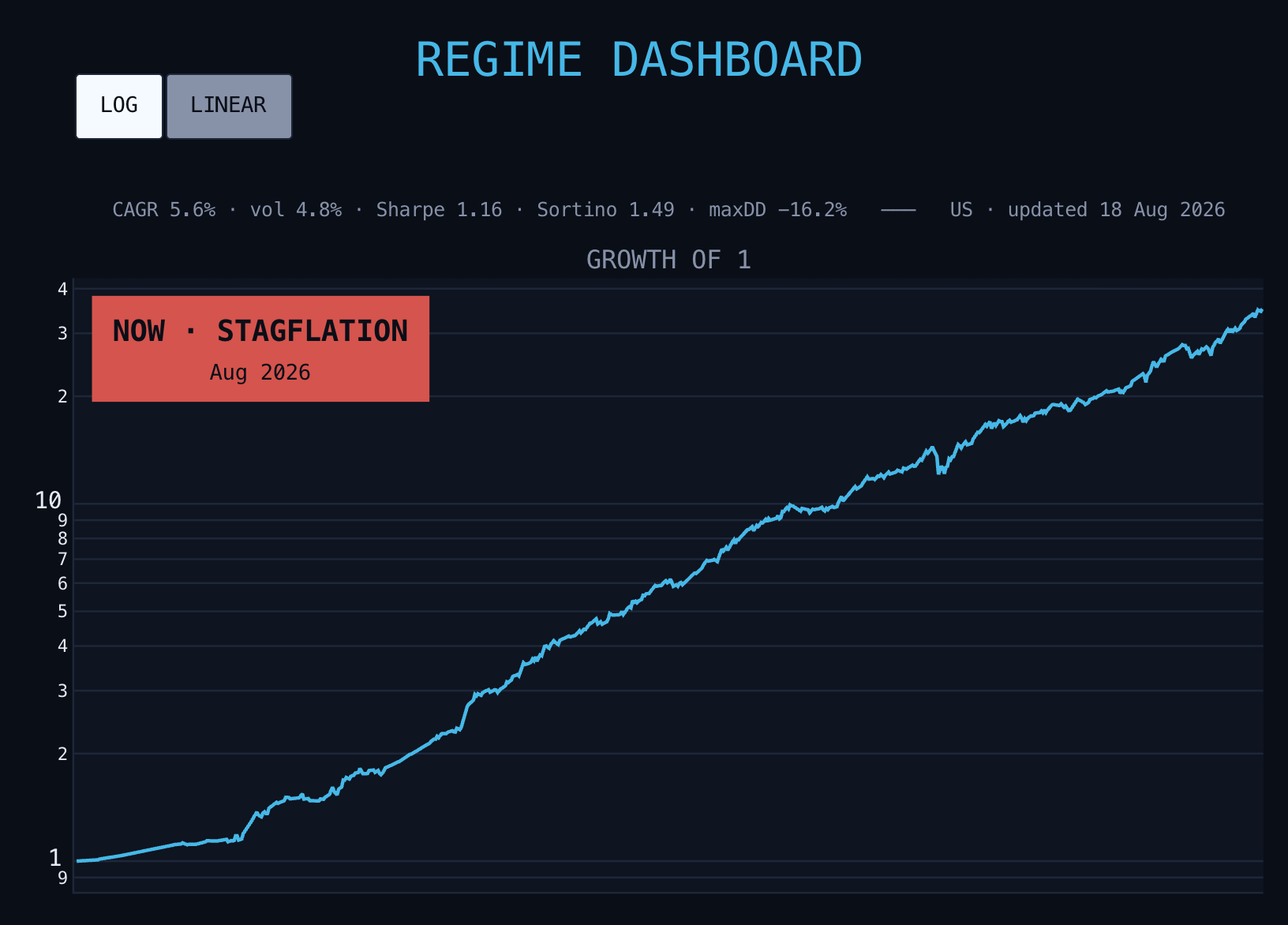
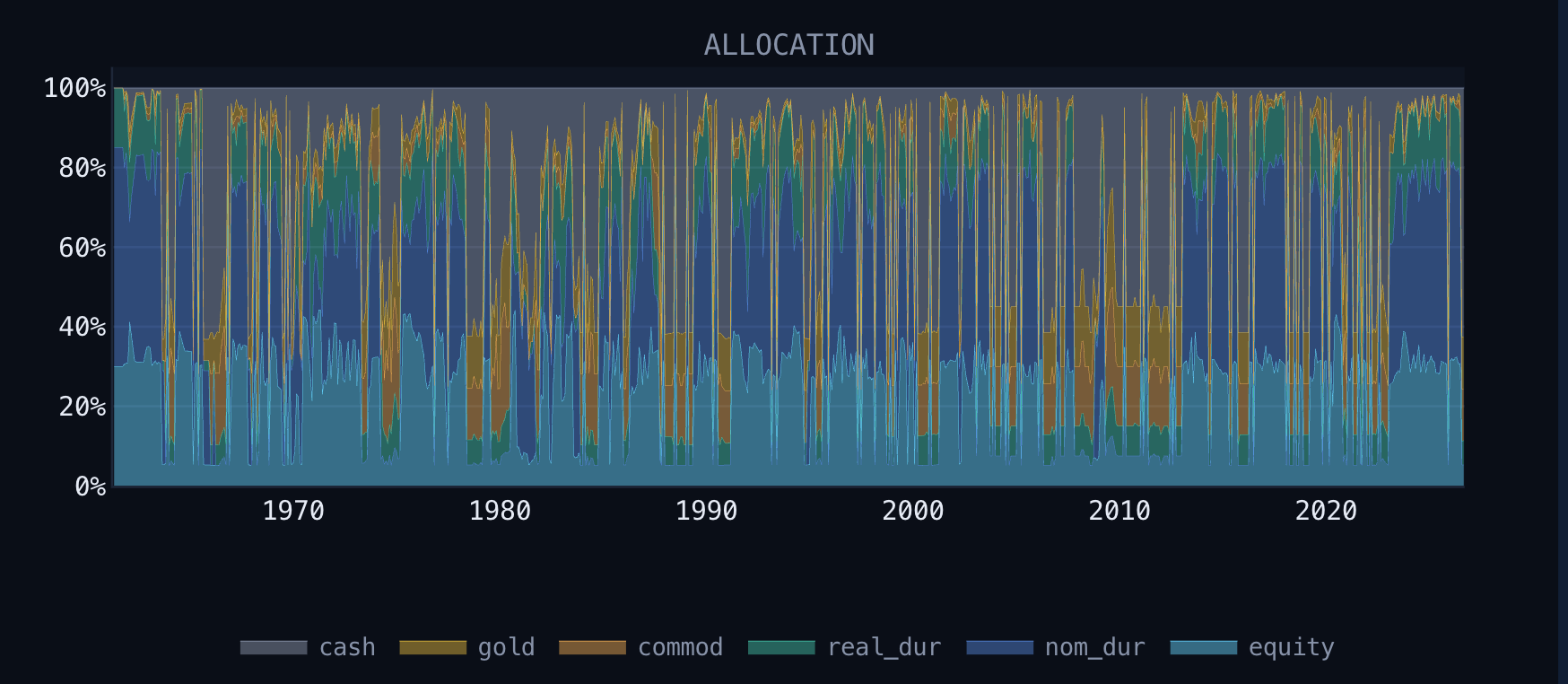
The newest addition features a regime dashboard based on a long-standing model I have been running since the 60s for the US. I have reworked the model a bit and added a few new layers to make it more robust. Each month, the model scans the regime attributes and decides its asset allocation based on conviction and regime robustness.
I built the model to generate attractive annualised returns over inflation, with limited drawdowns. As a result, it is not overly aggressive but maintains a healthy balance, with an overall Sharpe ratio that sits comfortably above 1.
Heisenberg taught physics a humbling lesson: you cannot know a particle’s position and its momentum at the same time — not because the instruments are crude, but because the two facts are fundamentally at odds. Markets have their own version. You cannot know exactly where you are in the cycle and where it is going at once. The data that tells you where you have been is lagged and revised; the prices that tell you where you are headed are noisy and prone to lie. Certainty about your position in the cycle is not on offer, and anyone who claims it is selling something.
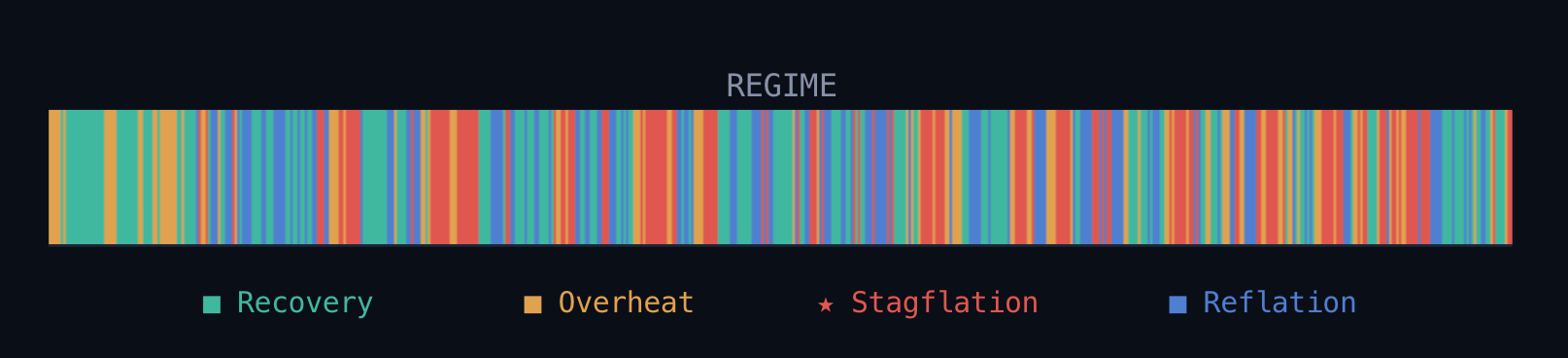
But you do not need certainty. You need a good-enough fix. And here markets are kinder than the analogy suggests: prices and economic data, taken together, triangulate your position on the cycle well enough to act on. Prices lead and mislead; data lags and confirms; between them they place you on the regime clock with enough confidence to allocate differently. The whole model rests on that wager — not that the cycle can be predicted, but that your position on it can be read.
Which matters, because the alternative is to allocate as if position were unknowable — and that is what a static book does.
Why static allocation fails
A 60/40 book holds bonds to cushion equities. In 2022 it lost on both legs at once and posted its worst drawdown in decades. The reason is the part worth dwelling on: the force that hurt equities — real yields spiking as the Fed tightened into inflation — was the same force that destroyed bonds. The diversification failed at precisely the moment it was meant to work.
That is not a flaw in the 60/40. It is a flaw in the idea of any fixed allocation. No set of static weights can be right across every regime, because the regimes are opposites. What protects you in a deflationary crunch — long duration — is what ruins you in an inflationary one. A book that holds the same weights through both is guaranteed to be wrong in at least one of them.
What it does
The model locates the economy on the two axes that define the cycle—the direction of growth and the direction of inflation — and reads the level and direction of real yields on top. Between them, those tell you which world you are in: expansion or slowdown, rising or falling inflation, and — critically — whether a move in yields is a deflationary event you want to own duration into, or an inflationary one you must not.
None of the ingredients is exotic. The cycle-clock idea is decades old. What matters is not the concept but whether it survives honest testing — and this is where most regime models quietly fall apart.
What the results showed
I ran it across sixty-five years, deliberately including the 1970s inflation and the Volcker shock — the regimes that barely exist in the modern record and that flatter a model tested only on recent data. Every signal is computed walk-forward, using only what was knowable at the time.
Three things held. The cycle phases genuinely discriminate—each clears a sixty-per cent hit rate on large samples, stable across independent eras. The model beats a static book on a risk-adjusted basis out of sample, with a higher Sharpe and a materially shallower drawdown. And it handled 2022: where the static book fell into the teens, the regime model lost low single digits, because it read the inflationary shock correctly and stepped out of duration rather than into it.
Obviously, it does not make more money than holding equities in a bull market. Nothing defensive does. It is a risk manager, not a return machine, and it is honest about which.
The US model, in short, has done a tremendous job — and it does it across the full palette a regime framework needs: equity and duration on the growth axis, cash to stand aside, and gold, commodities and inflation-linked bonds to be positioned when inflation is the driver rather than merely hiding from it.
For members, I've added more detail on the model’s workings below.
