

Late Friday Thoughts
Thoughts from the Hills / Bond yield breakouts

I have spent the past few days hiking through the hills and valleys in the rainy British North with little reception. I planned this by design as I cherished some detox from screens and constant market news. I only checked markets yesterday evening after returning to a hotel with access to the worldwide information superhighway. Before I left, I sold down some of my equity risk exposure and moved to cash, as I didn’t see scope to further chase the rally from here. Much of my thinking was driven by the piece I wrote before this week’s CPI, which outlined how increased inflation volatility will drive markets and risk premia from here onwards. It’s the biggest macro driver from here. See details below.
The Return of Structural Inflation?

Amid the relative calm, I have been having a rare feeling of unease and excitement as I think about Tuesday’s US inflation print. While markets might be locked in on the AI story and keeping an eye on news from the Middle East, inflation might suddenly become more relevant than usual.
Looking at my screens, I am very comfortable with the decisions I have taken before I left. Rates are being repriced globally, which supports my hypothesis. In addition, bonds now seem to also put the brake on risk premia across equities, credit, and emerging markets assets. Sure, it might only be a few days, but the overall framework I have set out is in play, and I am preparing accordingly.
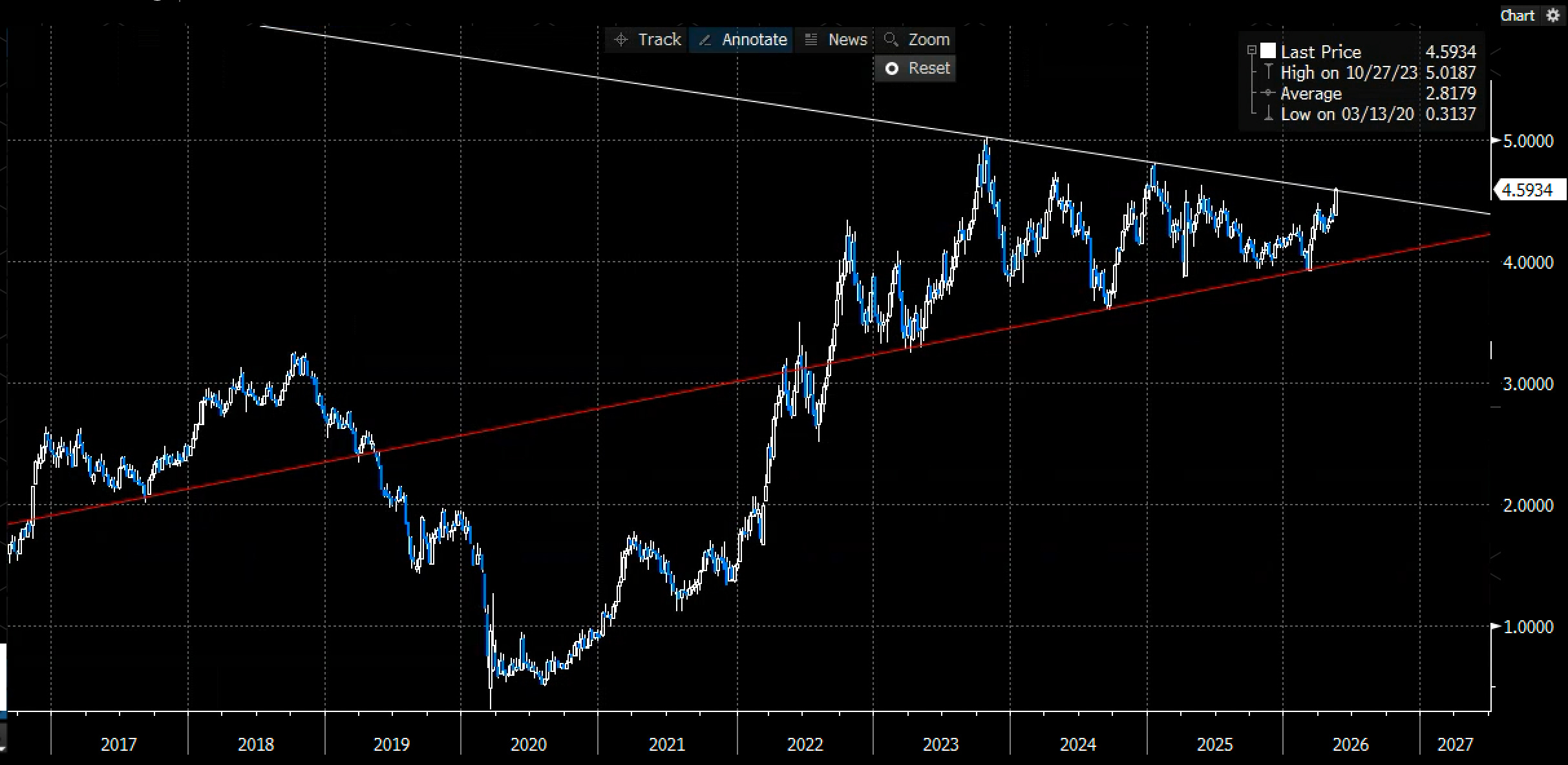
Technically, the story is also building with US 10-year yields touching long-term trend lines, which looks like a bull flag (in yield terms) building for a breakout.
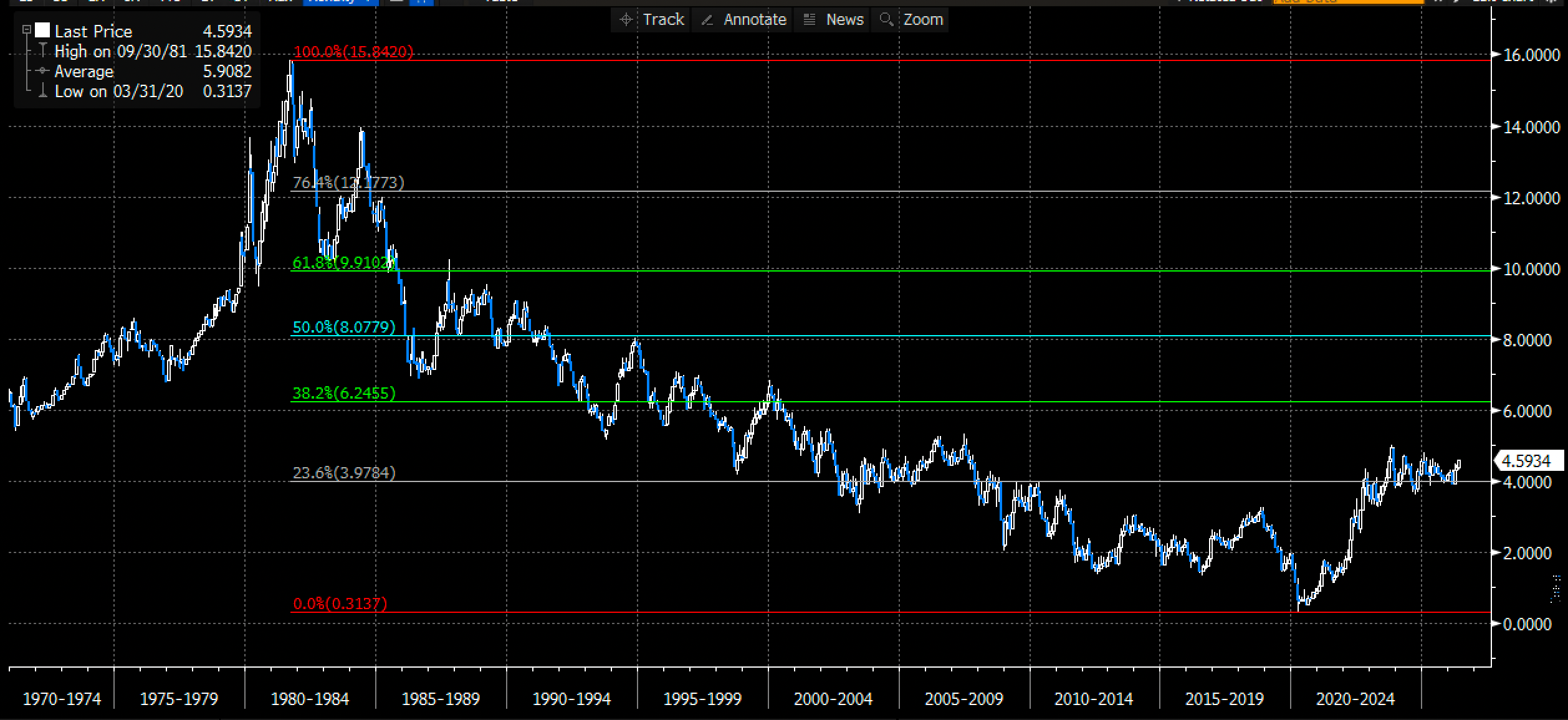
On a longer time-frame, you can argue that the recent inflation impulse should justify a level of retracement of yields to 6.25% as a possible target - a level last seen at the start of the millennium.
I think volatility across assets is vastly underpriced. Many are still living in the vision of a low-volatility era, which was never a natural state to begin with. It was engineered: rates pinned, term premia crushed, uncertainty managed, and every drawdown trained to expect a response. If that framework is now constrained by stickier inflation, heavier fiscal issuance, and more obvious supply bottlenecks, then volatility stops being a temporary visitor and becomes part of the furniture. And if that’s true, the real risk isn’t the next shock — it’s our reflex to treat every shock as a mistake that will be corrected, rather than a feature of a system that’s repricing the cost of risk.
This is the design of a new investment regime in which old macro models no longer work. What doesn’t change are tools like our models, which capture human behaviour in this changing landscape. A reminder that pa-globalmacro.com now houses all model outputs, and readers can choose to receive daily updates straight to their inbox.
The above is exactly why we keep coming back to “reference points” — the idea we wrote about in the PTJ piece. Not copying trades, not worshipping outcomes, but internalising a way of seeing: how uncertainty is handled, how losses are carried, how conviction is sized, and how ego behaves when the tape refuses to cooperate. It’s a discipline-light you follow, not because it guarantees success, but because it keeps your path honest when regimes change, and the old map stops matching the territory.
If PTJ were 33 again today, what would he do?

I am sure many of you have listened and / or watched the recent interview with Paul Tudor Jones (PTJ). If not, find the full roughly hour-long interview below, which is filled with wisdom in all corners between investing and life.
Which brings me straight to frameworks. In a shifting regime, plenty of changes — correlations, term premia, the cost of carry, the reliability of the “put.” But some things don’t: the need for humility, for process, for risk to be defined before the market defines it for you. The success of this place isn’t built on luck. It’s built on observation, humility, and the stubborn desire to seek truth through the lenses of well-tested frameworks — and then to apply them with rigour, especially when it feels emotionally inconvenient.
If you want to follow your curiosity and connect with like-minded people, consider joining the community. Please note that the subscription price now includes exclusive access to pa-globalmacro.com, including all future features.
Behind the paywall, our friend and co-contributor Macro D reflects on the week just gone and its implications on his Macro FX positions.
Have a wonderful weekend.
