


So we have had quite the week, culminating with the ceasefire announcement on Tuesday night. Markets rallied, and 10 and 15-point plans were circulated, which seemingly neither party had yet reached an agreement on.
Is this it? I don’t think so. I didn’t lift a finger or change anything in my trades. Markets moved into a new equilibrium, seemingly removing nasty tail-risk scenarios, while we are still far from finding an agreeable endstate for all involved parties.
There is still economic and vast infrastructure damage, with its waves still finding their way into macroeconomic variables. There is virtually zero chance that markets have priced this perfectly, so volatility will remain high for the coming weeks.
A good video (35 minutes) to watch in this regard is the interview with Niall Ferguson, which sharpened something that feels underpriced right now. His point was simple: Iran may think it’s winning — and that belief matters. Not because it is winning in a conventional military sense, but because it hasn’t lost. It can still impose costs, still disrupt flows, still deny the U.S. and Israel a clean, decisive outcome. In geopolitics, that’s often enough to claim victory.
That creates a dangerous mismatch. The West — and markets by extension — are leaning toward resolution, toward a narrative that this is stabilising, contained, heading toward closure. Iran, on the other hand, is operating as if the game is still very much on. And if one side thinks the war is ending while the other thinks it’s in a shifting phase, you don’t get equilibrium — you get a second move.
What matters here isn’t the headline ceasefire, but the persistence of leverage. Iran doesn’t need to dominate the battlefield; it needs to retain the ability to disrupt the system — oil, shipping, regional stability. As long as that remains intact, the conflict hasn’t been resolved; it has simply changed form. That’s the piece the market is going to struggle with.
The result is a familiar setup: perceived closure versus actual continuation. Markets price the end of the story, while the actors inside it are still writing the next chapter. And when that gap closes, it rarely does so quietly.
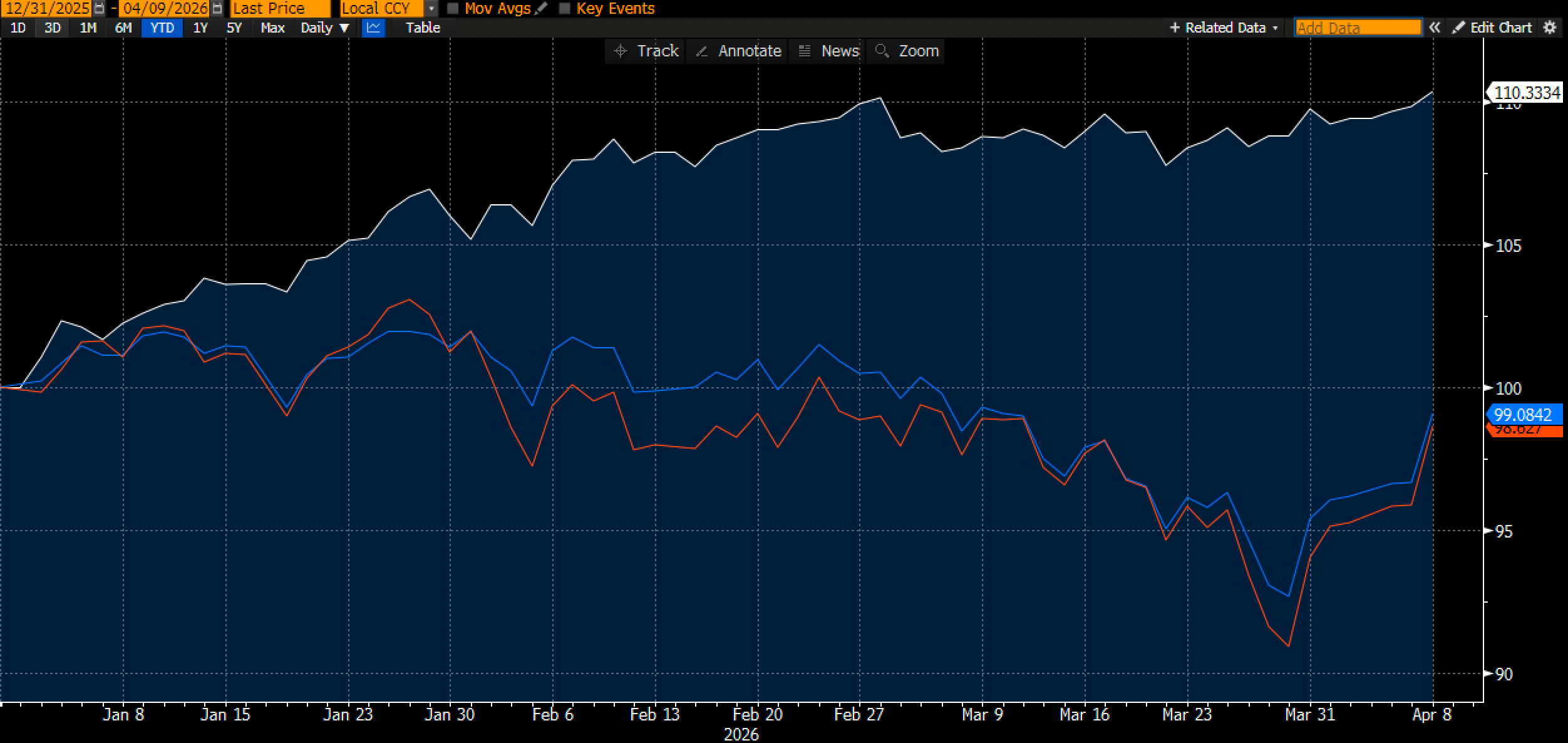
As for my strategy, the buy-and-hold portfolio has hit a new high as of Wednesday's close, now standing at +10.33%, comfortably outperforming both the SPX and NDX. The allocations, coupled with the hedges, are still working. As for my general trading, there is no rush, as I believe patience will be rewarded. Equities and bonds will likely be in a range, and I want to avoid being drawn into the noise and rather observe and plan when to engage. There will be plenty of opportunities ahead.
The newly launched dedicated site for all my technical models has been well-received so far. The dashboard, individual charts, and signals are updated daily. I am working on additional tools, but will only launch once I’m happy with their quality, so stay tuned.

For all new subscribers or those considering joining the pack, the dedicated technical macro offering on pa-globalmacro.com is now available as either an add-on to your current subscription or as a standalone plan directly on the site. Everything you know and love stays right here — the regular publications, thought pieces, and educational content aren’t going anywhere.
Also, a reminder that you can use my trading models in TradingView scripts, which I made available for subscribers to use on their charts. This is not free and also incurs an additional cost. These are the momentum, reversal, and intra-day models I often reference. If you are interested, ping me an email with your TV username. Note that only paying subscribers will be granted access. No exceptions.
Let’s now revisit something that’s been on my mind and won’t change, regardless of whether we see a resolution, as the damage of a supply shock is still very real. How should central banks treat this shock? In particular, how has the Fed previously reacted, and what can we reasonably expect this time around? We know the ECB is trigger-happy given its sole inflation mandate.
I am revisiting a fascinating paper (no pun intended) that asks a deceptively simple question: Does the Fed treat all inflation the same? Spoiler — it doesn't. The results, however, have serious implications for how we should think about the current policy mix and what it means for rates and risk assets.
Our friend Macro D also has some thoughts to share from his perch. His running book of Macro FX trades has continued to perform well as he updates us on his latest calls.
Let’s explore.
