

Friday Thoughts
Are Real Rates attractive? / Macro Charts Study / Macro Week in Review

This week can be summarised in a few sentences. The much-awaited CPI print came in just as expected. Bonds moved a little, and the curve steepened, yet we had to wait for PPI for people to get a bit more squeezed on their bond shorts, which started to rally. Admittedly, this was also helped by softer oil prices. Stocks, after struggling to break new highs, took the news in stride and launched into new local highs. Gold initially held its recent highs but then retraced, as predicted by our reversal model (users can see this in the dashboard or the individual charts posted daily over at pa-globalmacro.com).
The setup is bullish, earnings are solid, and the technical picture is scanning for a break higher in US stocks. The bigger question I have been asking myself, however, is what it takes for Treasuries to find a better footing and start performing. This cycle is like no other, with rate cuts that began in 2024 resulting in more than 100 bps of a bump in long-dated Treasuries, which now offer 3% in real terms — the highest since 2008, and a world away from the sub-1% purgatory that defined the entire 2010–21 cycle, when the same instrument bottomed near 0.3%.
Set that against the long-run real return on US equities of roughly 7% a year — the compound, inflation-adjusted, dividends-reinvested figure that has held remarkably steady across a century of data — and the gap has compressed to about four percentage points. That is not an anomaly; it is, to a good approximation, the historical equity risk premium over bonds. What today’s real yield really represents is the bond side normalising back toward its long-run relationship with equities after a decade and a half of financial repression that made forgoing stocks for 0.5% real an obviously losing trade.
The trouble with that four-point gap is that the seven isn’t the forward number. That figure was earned largely from sensible starting valuations, and starting valuations today are anything but: with the US market’s CAPE in the mid-thirties, the standard models imply a forward decade of only 2–4% real from equities, which is why the implied US equity risk premium currently sits close to zero. So the honest comparison is not 3% against 7% — it is a guaranteed 3% real, inflation-protected and locked for thirty years, against an uncertain 2–4% real that carries the full weight of drawdown and sequence risk.
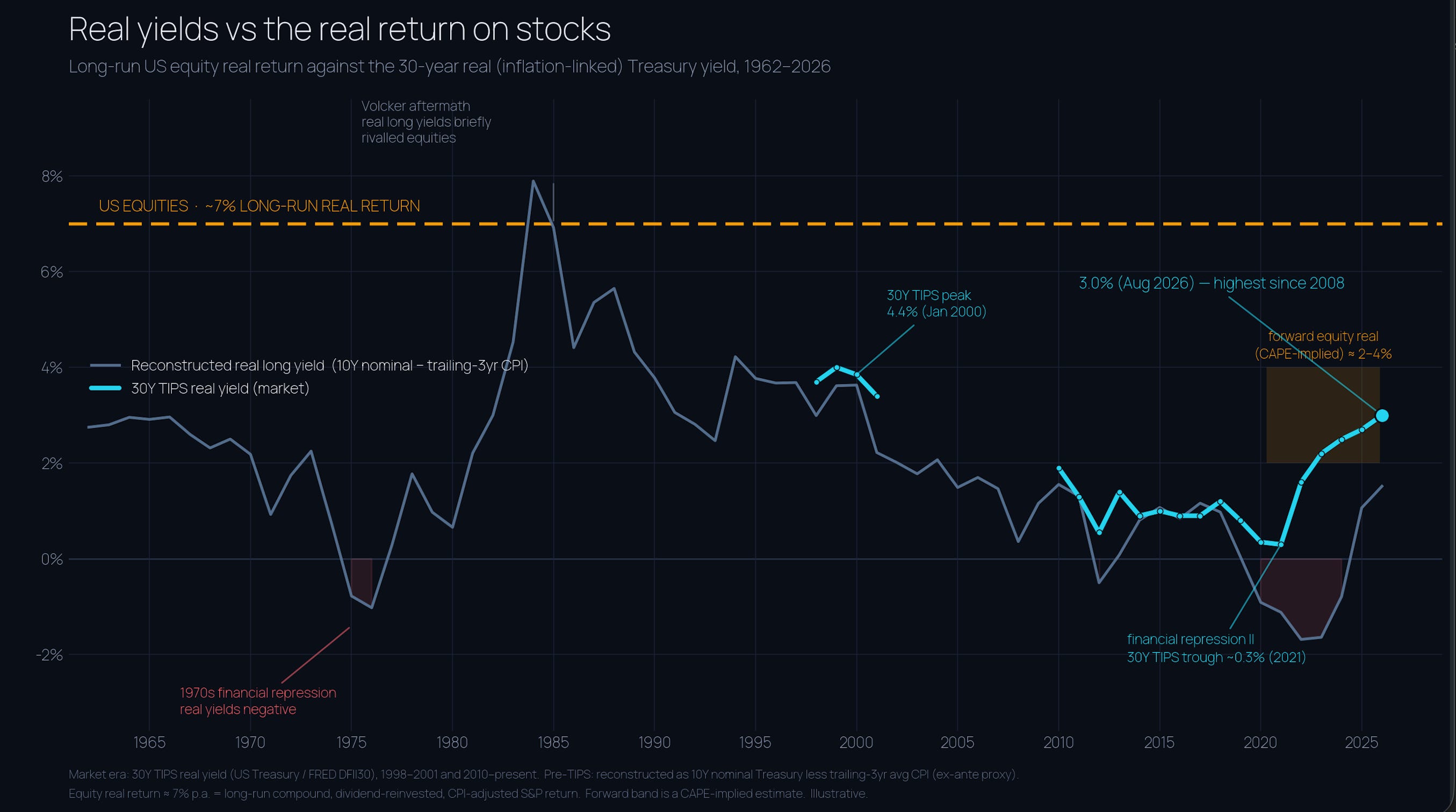
None of which means bonds beat stocks over thirty years — over genuine multi-decade horizons, US equities have essentially always won, and 3% real still sits below the equity long-run average. As always, the one caveat worth pricing is entry. If your macro read is renewed hiking risk and stickier inflation, long-end real yields can push higher still — a move toward 3.25–3.5% would hand a mark-to-market loss to anyone buying at 3% today before the coupon rescues them. For a hold-to-maturity investor locking a real return, that risk is academic, and 3% is a gift. I will spend more time on real yields, especially for those of you looking to retire over the next few years, as locking in real liability cash flows is currently very attractive. More on this soon.
For now, let’s look at three interesting macro charts and trade setups I have been studying and read Macro D’s latest thoughts on the trading week. He wrote a great piece mid-week about the philosophical makeup of what he believes a truly great macro investor is characterised by. See below. I wouldn’t miss that one.

