

Attack the Week (ATW)
Next Act of War / Calendar / Charts / Asset Allocation Model

Sunday Thoughts
Stories don’t unfold in straight lines. They unfold in acts.
A first act in which the premise is established, and everyone thinks they understand the plot. A second act in which the story complicates itself, characters reveal their true motives, and the audience begins bargaining with reality. And then the third act—where consequences arrive, usually late, usually heavier than expected.
We like to pretend geopolitics is different. That it’s a headline, a spike, a fade.
But the current situation isn’t dissimilar to theatre. A war has been raging for a month now, while we were told—or perhaps we told ourselves—that it would be over soon.
Maybe we weren’t lied to. Maybe we were just hoping.
Financial markets, in their messy, complex-adaptive way, move from one act to the next, just as a crowd changes its mood. Not dogmatically. Not cleanly. Always probabilistically. One piece of information doesn’t “decide” anything. It nudges the distribution.
We hoped for TACO. We had signs, little flashes of “productive conversations,” the kind of headlines that feel like the curtain is about to fall, and we can all go home. And then they didn’t turn out to be true—or at least not true enough to matter, not for now.
That’s the part nobody enjoys: when the hope rally is built on a story that can’t carry weight.
I took a long walk through London over the weekend. More than ten kilometres, stopping at a few of my favourite pubs along the way. People were socialising and drinking as if it were any other weekend. Talking to friends revealed nothing unusual either. No sense that the world was ending. No collective trembling.
So I asked myself: Is it us?
Is it the financial world—entrenched in hourly candles and daily gyrations—that begins to feel apocalyptic in what is, for most people, just another month on the calendar?
If you read the right tweets, you’d swear civilisation was in its final chapter. But systems don’t turn on a tweet. They turn on time, on realisation, on pain.
And last week, we saw more pain creep into places that had been resilient for far too long. The S&P 500 is down roughly 7% year-to-date and around 4% over the last six months. That’s not a catastrophe, but it’s nothing either. Wealth effects don’t announce themselves with sirens. They bite quietly. Confidence frays at the edges first, then spending, then hiring, then margins.
Friday’s market reaction felt like another small shift in the play. Front-end yields rallied while gold lifted at the same time. That combination always makes me pause. It whispers that the market is starting to look past the inflation spike and the repricing of rate cuts/hikes—and toward the next act.
A world where growth and margin assumptions get repriced under the weight of supply constraints and their inflationary aftertaste, and where demand starts to bend.
That’s the phase that deserves respect.
Because this is when correlations can flip. This is when what “always works” starts to fail. This is when markets stop pricing a single path and start pricing a wider tail.
And in that environment, being clever is less useful than being prepared.
That’s the work of PA–Global Macro. Not predicting the plot, but tracking the scene changes. Not trying to be roughly right with a big narrative, but refusing to be precisely wrong with a fragile one.
Our buy-and-hold 2026 portfolio (white line below) is up 8.8% YTD and comfortably outperforming the SPX (blue) and Nasdaq (red).
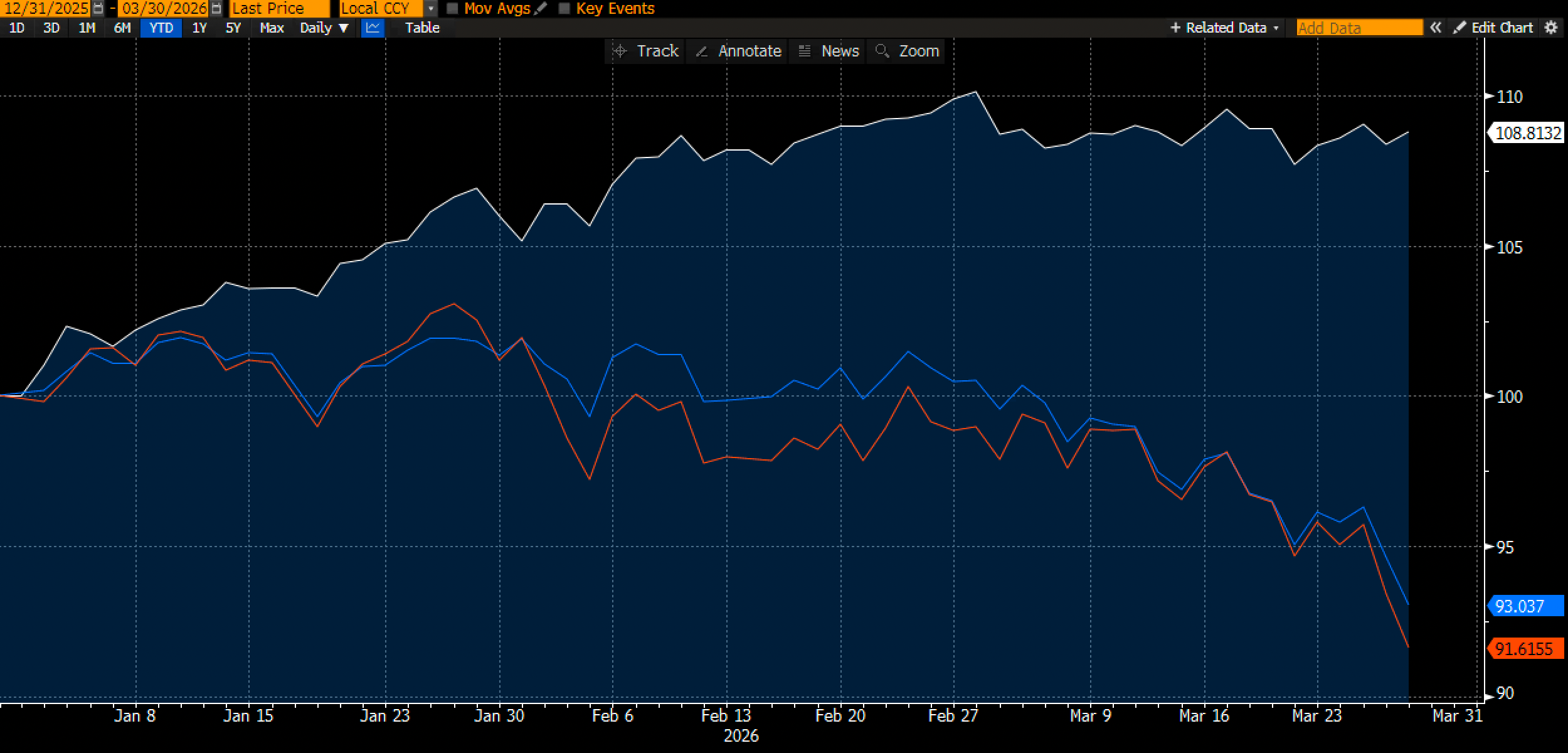
The new dashboard—covering the major global macro markets—is being built to do exactly that: give us a clearer read on where the road is headed and when the system's tone is changing.
On the S&P 500 specifically, the model shifted to a short on February 13. Since the signal fired, that’s been close to a 7% move in our favour. Not because we “knew” anything, but because the process was ready when the act changed.
Existing subscribers will soon see their subscription value augmented again, as I roll out dedicated models and strategy frameworks I’m building around these regime shifts.
If you’ve been thinking about subscribing, now is the best time to join the pack. I’ll be grandfathering all current subscribers into the expanded offering. Pricing and access will change going forward, because the product is changing too. More tools and more time spent creating valuable inputs for the community.
Let’s now explore what we always do for our members. Analyse the weekly calendar and scan for a few interesting chart setups. We then get our friend Macro D (a fine Macro FX brain) and his thoughts before we close with the output of our long-standing asset allocation model, which has turned off allocations to both bonds and equities over the past few weeks as it scans for re-entries. Will it be changing anything this week?
We shall see. Rest assured, we are ready for the next act.
That’s the thing about acts.
They don’t wait for us to be comfortable.
They just change the lighting—and reveal what was always there.
Let’s explore.
