


Sunday Thoughts
As mentioned, I am travelling this weekend, and Macro D is on a break. Don’t worry, he is watching his FX book like a hawk and will update us all very soon. My Friday thought piece comparing Bessent to the Dude was my initial take on last week’s development and market reaction. This has now turned next week’s Jackson Hole speech (Friday, 10 am; see calendar below) into a meaningful event, possibly more important than any FOMC meeting Warsh has covered so far. But what can he really say?
Friday Thoughts

I am travelling this weekend and Macro D is on a well-deserved break, so I am echoing thoughts that have been accumulating in my head over the past week. Most of it, you wouldn’t be surprised, focuses on Bessent’s mini-twist operation and signalling over the week.
The problem for Warsh is that this is not a monetary policy challenge; bond markets are currently testing governments globally. A reminder that the Treasury’s decision to double the size of 10–30 year buybacks is not QE: the purchases ultimately have to be financed through issuance elsewhere, most likely bills. It is better understood as a Treasury-led Operation Twist, reducing the duration the private sector must absorb while increasing shorter-dated financing. The timing alongside US participation in Japan’s FX intervention is also notable. Japan remains the largest foreign Treasury holder, while a weaker yen and increasingly attractive JGB yields incentivise Japanese capital to return home. Supporting the yen therefore also helps contain a potential source of Treasury selling.
The problem Warsh cannot fix is that the fundamental backdrop is moving in the opposite direction. The US deficit is again running above 6% of GDP, inflation remains around 3%, and commodity pressures are building. At the same time, the generational AI investment cycle is creating an entirely new competitor for capital. AI capex has risen from roughly 200bn in 2024 to more than 800bn this year and increasingly requires debt financing, with hyperscaler issuance alone heading towards hundreds of billions of dollars. Treasuries are therefore competing with some of the world’s strongest companies for long-duration capital just as government borrowing remains enormous. It is difficult to reconcile that backdrop with structurally lower term premia.
This increasingly resembles a classic dollar debasement environment: higher gold, a weaker dollar, steeper curves, rising breakevens and, so far, higher equities. Bessent can potentially restrain long-end yields, but without tighter fiscal policy or a more credible inflation response from the Fed, the underlying pressure is likely to show up elsewhere. The more dangerous outcome would be Treasury openly attempting to stabilise the long end and failing. You can argue that last week’s intervention has not been successful so far.
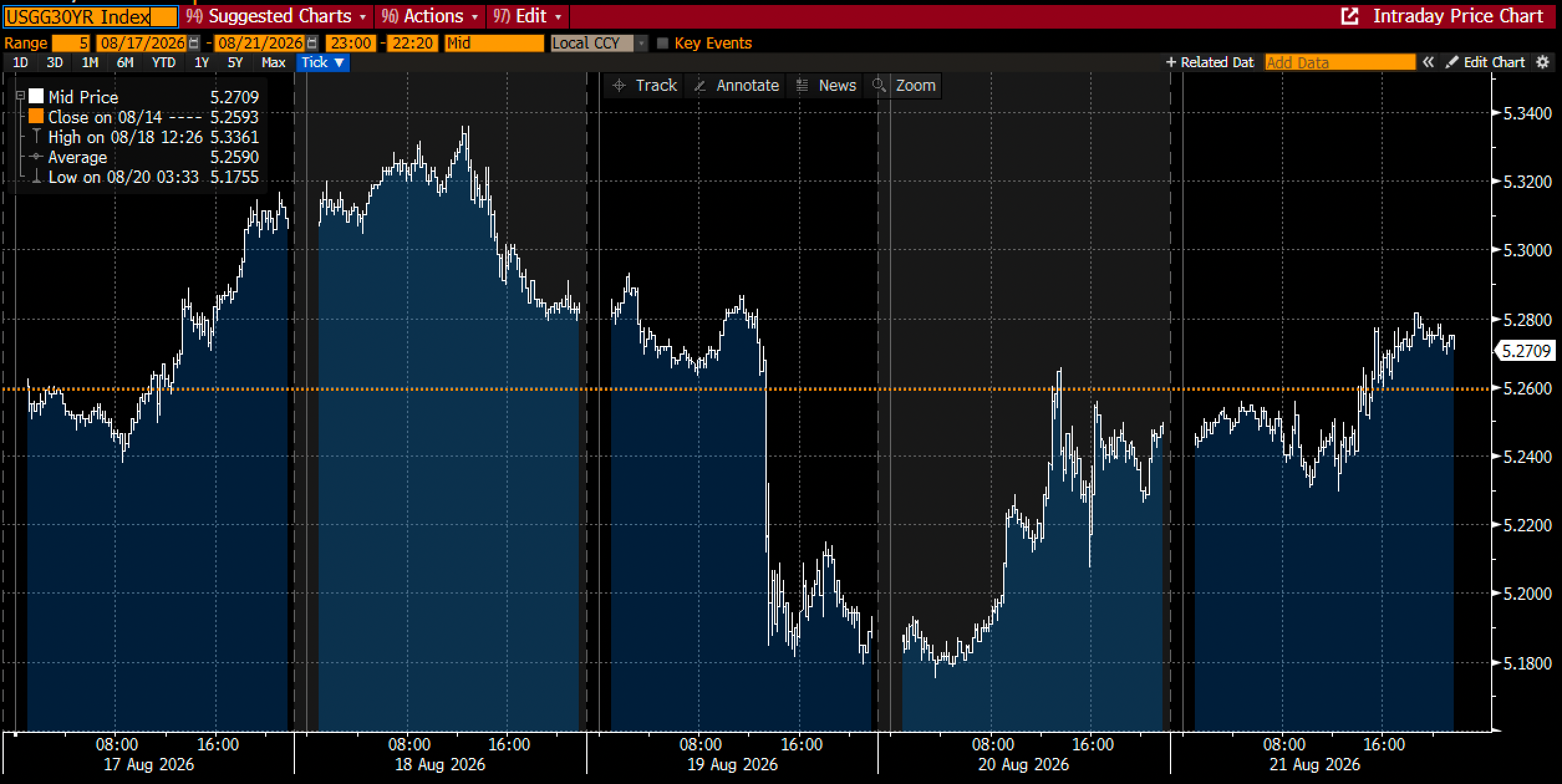
Warsh’s Jackson Hole speech therefore matters. A genuinely hawkish inflation message could do more for the long end than Treasury intervention; another dovish performance risks pushing the debasement trade into overdrive. The hawkish tilt theory gained momentum in late Friday trading as 2-year Treasuries suddenly started underperforming.
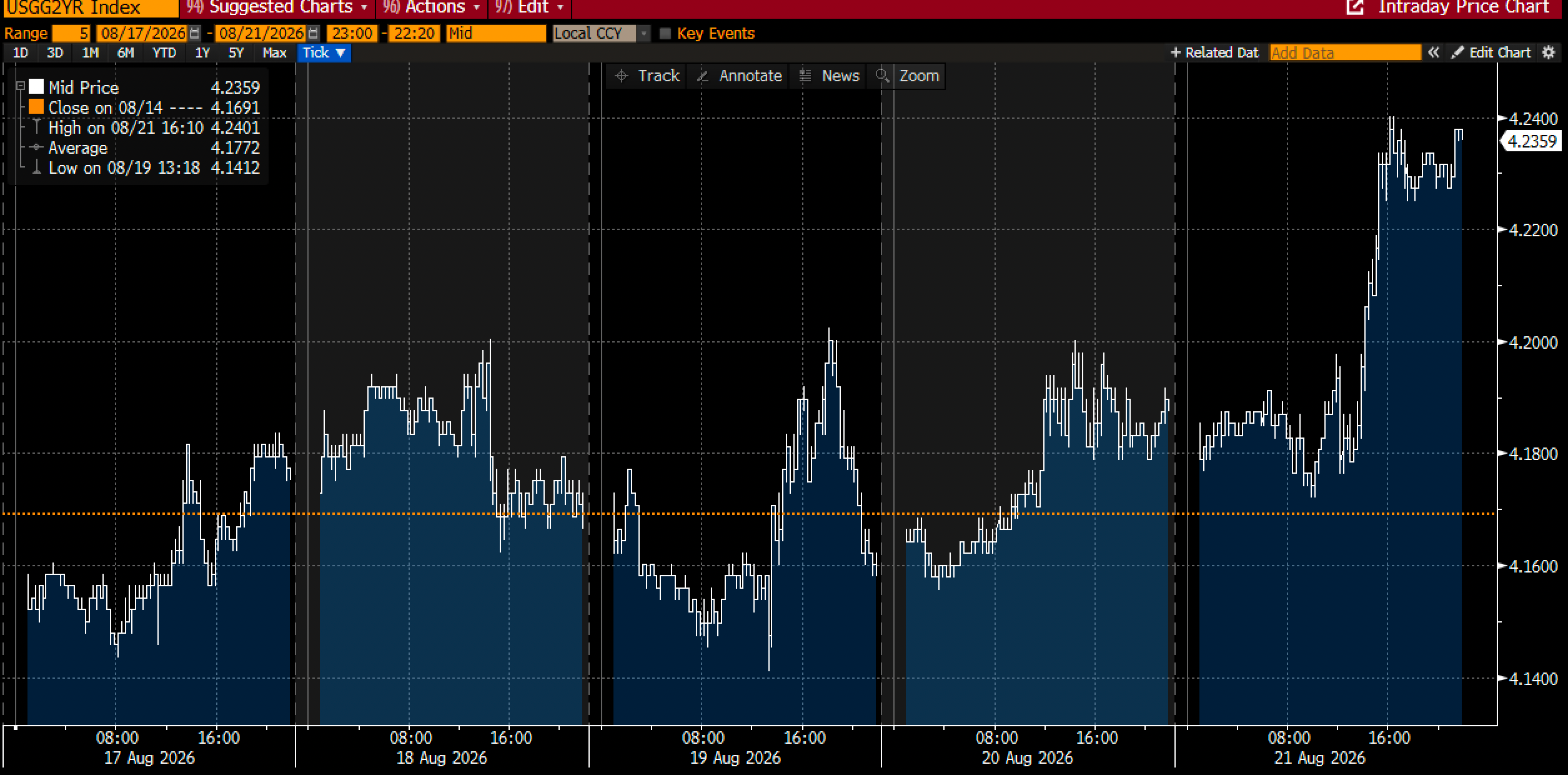
Warsh and Bessent talk regularly, but I am not sure how much they agree. Both have to do their own jobs, and right now Warsh has to restore some belief amongst investors that his institution is truly independent. The thing is, however, I am not sure about Warsh after his disastrous July FOMC presser. Of course, he has the total freedom to say absolutely nothing and simply enjoy the glorious Wyoming mountain air with his fellow central bankers. This wouldn’t help restore market calm. As such, the back-up in short-end yields may signal that he has no choice but to sound hawkish. How is that credible if no forward guidance is allowed?
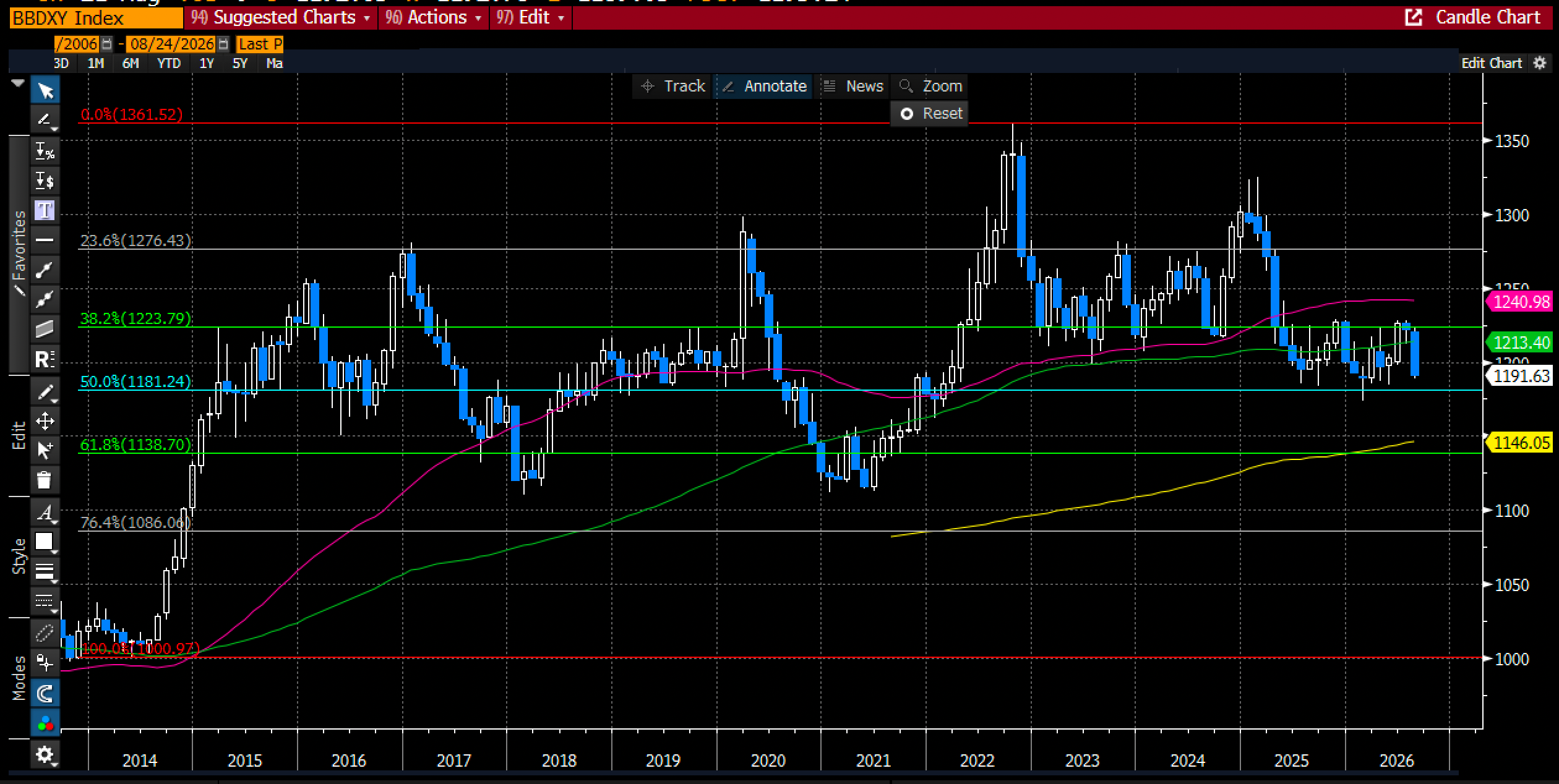
I’m looking at the long-term Dollar chart, which has been in this relatively tight range since liberation day last year. We tried breaking below the 50% retracement line, but failed, and similarly can’t get above the 38.2% retracement resistance either. Something has to give. The journey of the Dollar for me is lower, much lower from here.
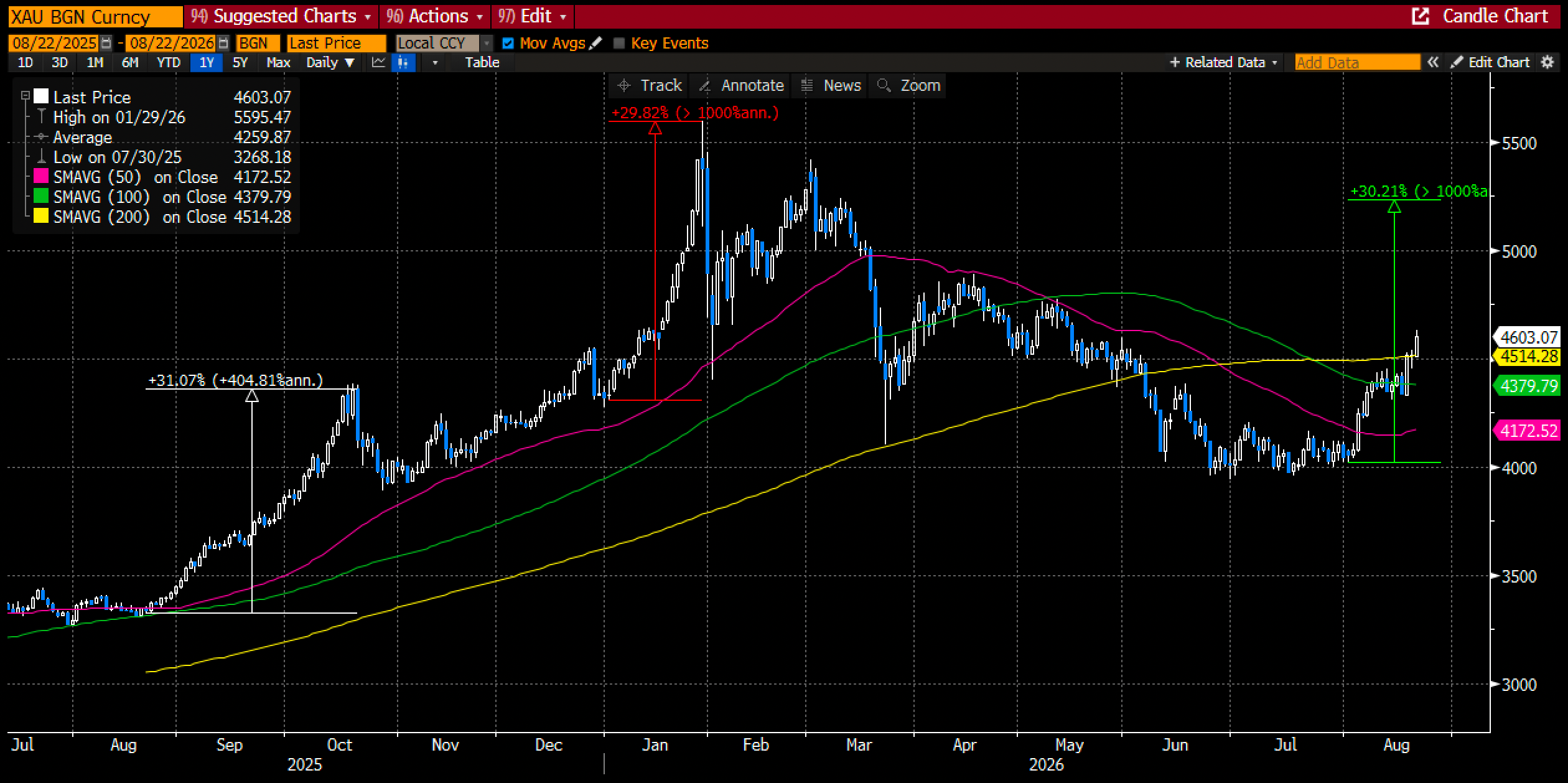
The anti-dollar trade can also be expressed in Gold, with the additional reserve-asset boost this precious metal is receiving. Last year, we saw a 30% ramp in a few weeks. Can the same thing happen again?
Now let’s look at the Weekly Calendar, the weekly analysis of our global macro dashboard and its key insights, and the latest output of our asset allocation model, which has been remarkably sticky in its allocation strategy over the past few weeks.
A reminder that the dashboard and the daily chart book (individual charts of more than 200+ global macro securities), signals, 2026 buy-and-hold portfolio, and sector rotation map are now available at our dedicated site at pa-globalmacro.com. As a paying member, you have automatic access to all current and future features of that site; simply log in with your email.
This week, I added a new feature: the regime model, which has tracked economic and market forces for decades, establishes a conviction-based framing of the underlying regime and then decides the appropriate asset allocation. I started this analysis for the US, but have now expanded it for the UK and Germany.

And there is much more to come. Never too late to join. Why not now?
